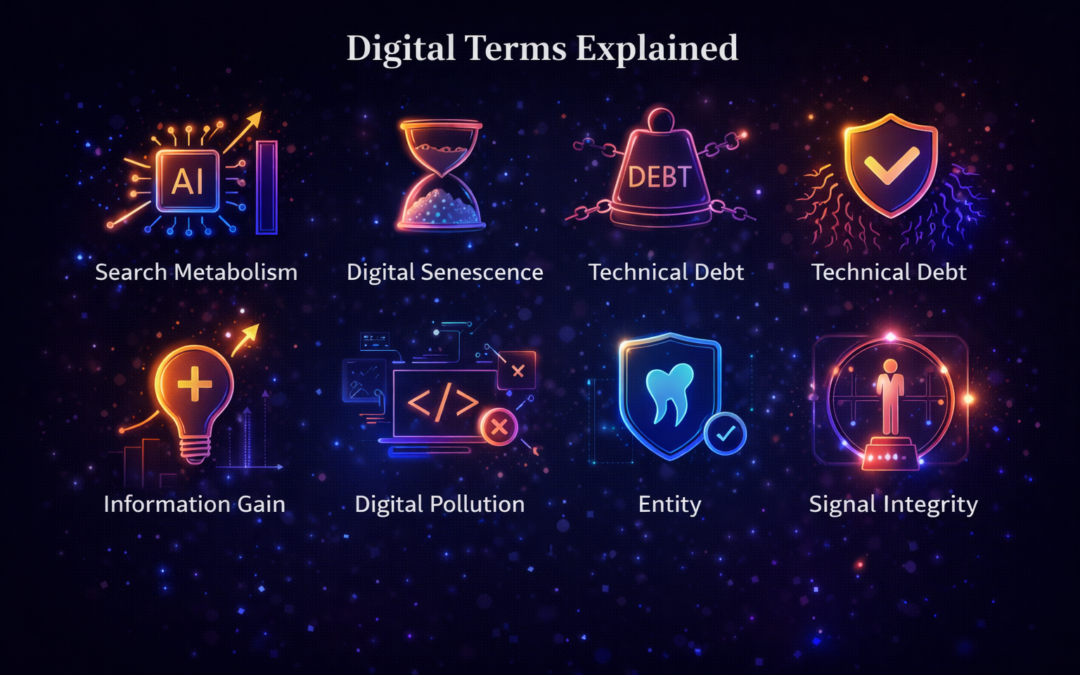

What is Technical Debt?
Technical debt is the hidden cost of choosing a shortcut over a structural solution. It is the accumulation of outdated code, fragmented data, and broken logic that forces your website to work harder than necessary.
In the context of search, technical debt acts as a barrier between your content and the algorithms that need to retrieve it. It is the byproduct of “quick fixes” that eventually slows your digital growth to a crawl.
A Note From the Field: Metabolic Efficiency
When I was a biochemist, we defined the health of a system by its metabolic efficiency. If a cell cannot process nutrients, it starves despite the abundance of food.
Digital ecosystems function under the same laws. You can buy more content and target more keywords, however, if your underlying infrastructure is burdened by debt, you are just scaling inefficiency. Cleaning your foundation is not a cost, it is the removal of a tax on every dollar you are spending to grow.
Four Common Drags on Your Digital Margin
Technical debt reduces the profitability of your digital investment in four specific ways.
- Acquisition Inefficiency
You may hit the correct keyword targets. But if the pages are slow to crawl or inconsistently canonicalized, not all of your potential reaches the audience. The money you spend on content generates fewer results than intended.This is a margin problem.
- An Operational Surcharge
A healthy site allows for rapid deployment of new products and campaigns. A debt-heavy site adds friction to every release. It requires more workarounds, more rework, and more QA. You pay a hidden surcharge on every future growth effort.This is an operating-efficiency problem.
- The Collapse of Compounding Returns
A technically sound site compounds value over time. Authority flows cleanly. New content is indexed and trusted sooner. Technical debt breaks this cycle. Assets take longer to become productive. Instead of building an appreciating digital asset, your company keeps funding partial replacements.This is an asset-performance problem.
- Invisible Resource Waste
Debt creates waste in areas you already fund. This includes content that never fully indexes, paid traffic landing on suboptimal pages, and engineering time spent on recurring fixes. Your business is bleeding efficiency underneath acceptable rankings.
This is a cost-control problem.
Case Study: The Cost of Unchecked Expansion
A Legacy of Drift
I recently audited a travel media brand with 20 years of digital history. Over these two decades, the site underwent dozens of redesigns, server migrations, and functionality experiments. They added podcasts, directories, and whitepapers on the fly. They swapped lead-gen systems and digital publication providers.
Each change was treated as an isolated add-on with little consideration for the existing platform.
The Diagnosis
- Code Bloat: The head code was flooded with redundant scripts from abandoned plugins and shortcodes that no longer resolved.
- Information Decay: Over 100 content categories existed. Most were created on a whim and subsequently abandoned, leaving hundreds of “thin” or empty nodes.
- Metabolic Waste: Thousands of unaudited pages contained broken images, unresized files, and duplicate content fragments.
- Signal Noise: Without a concerted schema effort or redirect strategy, the site architecture was a labyrinth of conflicting signals.
The Result
Despite having two decades of high-value authoritative content, the site’s “metabolism” had stalled. The search engines were spending their crawl budget navigating hallways of dead experiments instead of indexing new revenue-driving content. This is the reality of technical debt. It is not an IT inconvenience. It is a structural failure that suppresses the ROI of every new initiative.
Value Retention: Infrastructure as ROI
To begin evaluating your digital ROI, start by asking these underlying structural questions.
- Realization Rate: Can search engines consistently discover, crawl, and trust your data?
- Conversion Efficiency: Do your pages resolve cleanly enough to guide users toward business outcomes?
- Retention of Value: Does the authority of your content compound over time, or is it lost to instability and rework?
Translating Technical Friction into Financial Reality
To understand the impact of technical debt, we must view SEO language through the lens of financial behavior.
| Technical Symptom | Financial Reality |
| Canonical Inconsistency | Splitting the market signal across multiple versions of the same asset, thus lowering the yield on content. |
| Inefficient Crawl Paths | Diverting search engines to low-value pages instead of revenue-driving assets, resulting in delayed monetization. |
| JS-Dependent Rendering | Introducing avoidable friction between publication and discovery, slowing time-to-value on every page. |
| Fragmented Architecture | Building a system where growth costs more, performs less consistently, and compounds less than it should. |
The Supply Chain Analogy
Keywords and Entities are demand signals. Infrastructure is the supply chain. You would never ignore warehouse efficiency while buying more inventory. If the supply chain is weak, fulfillment costs rise and margin erodes.
Performance in isolated parts of the system does not prove the system is healthy. It only proves some assets are strong enough to overcome the drag. The financial question is how much additional return your organization would realize if the drag were removed.
Technical debt is not a website issue, it is a revenue-efficiency issue. Don’t leave money on the table.
About the Author
Lance Harrell is the lead Digital Development Consulant at Digital Consilience. With over 20 years of SEO experience and advanced degrees in Biochemistry and Molecular Biology, he applies data-driven forensic rigor to search challenges.