We use specific terms to describe the health of your digital systems. This page defines those terms in simple language. It acts as a guide to help you understand our technical plans. We provide these definitions to confirm that our strategy is clear, helping you recognize the signals that verify your brand is the top answer in search.
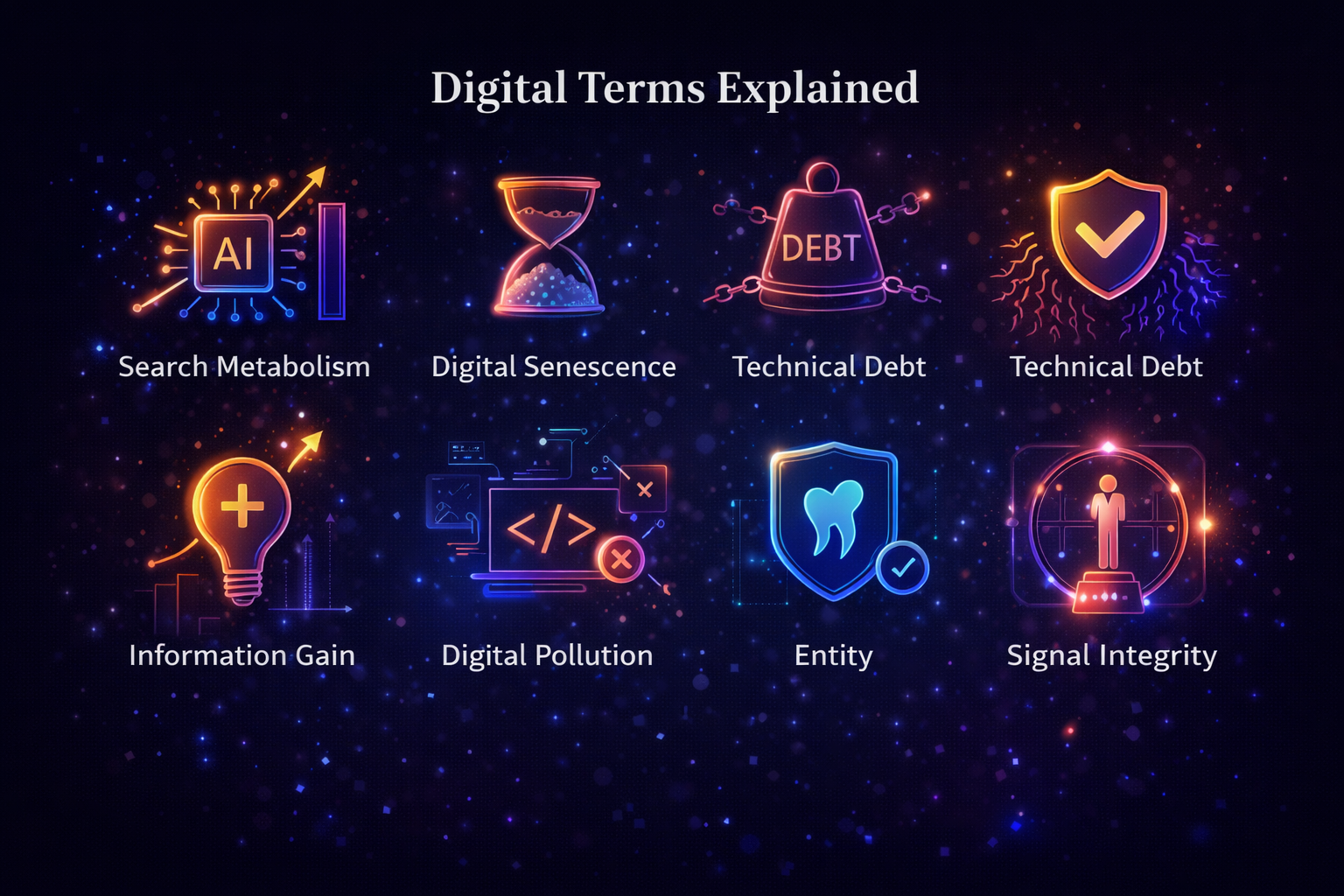
Search Metabolism: The speed and efficiency of a website infrastructure. Just like a biological metabolism, a healthy site processes information quickly to fuel growth.
Digital Senescence: The biological-style aging of a website. It describes the state where old code and outdated structures prevent a site from functioning at peak health.
Schema, A specific code that labels the information on your website so search engines can read it without confusion. It acts like a standardized labeling system in a laboratory, verifying that every piece of data is correctly identified and categorized for the system.
Technical Debt: The long-term cost of choosing easy, short-term fixes over high-quality engineering. It acts as a heavy tax on your revenue and growth.
Information Gain: The unique value or new data that your website provides. If your content is the same as everyone else, it has no information gain and is often ignored by modern systems.
Digital Pollution: Low-quality, repetitive content that clutters the internet. It makes it difficult for search engines to find the high-fidelity information users actually need.
SEO (Search Engine Optimization): The foundational work required to verify that your website is visible and readable to search engines.
AEO (Answer Engine Optimization): The process of formatting your data so that AI systems and voice assistants can give direct, accurate answers about your business.
GEO (Generative Engine Optimization): The strategy of proving your brand is a trusted authority so that AI models like ChatGPT or Gemini choose to cite you in their responses.
Citation Share: A measurement of how often AI tools recommend your brand as the specific source for an answer.
Entity: A recognized, verified identity in the digital space. Modern search engines focus on these real-world “things” rather than just looking for specific words.
Signal Integrity: The strength and clarity of your digital footprint. High signal integrity confirms that your brand stands out from the noise of the web.
Proximity Intelligence: The technical engineering that confirms your business is the top recommendation for people searching in your specific local area.
Technical Substrate: The underlying code and server environment that supports a website. A stable substrate is the first requirement for any digital growth.
Source of Truth: The most reliable and verified piece of information on a specific topic. We engineer your site to be the source that search engines trust most.
Schema: A specific code that labels the information on your website so search engines can read it without confusion. It acts like a standardized labeling system, verifying that every piece of data is correctly identified and categorized for the system.
About the Author
Lance Harrell is the Lead Systems Architect and Senior Operator at Digital Consilience. With over 20 years of SEO experience and advanced degrees in Biochemistry and Molecular Biology, he applies forensic rigor to the search landscape. He prioritizes the systemic health of digital infrastructures to verify that brand growth is both scalable and durable.